
What makes a car photo look professional?
Last updated: 2026-10-30
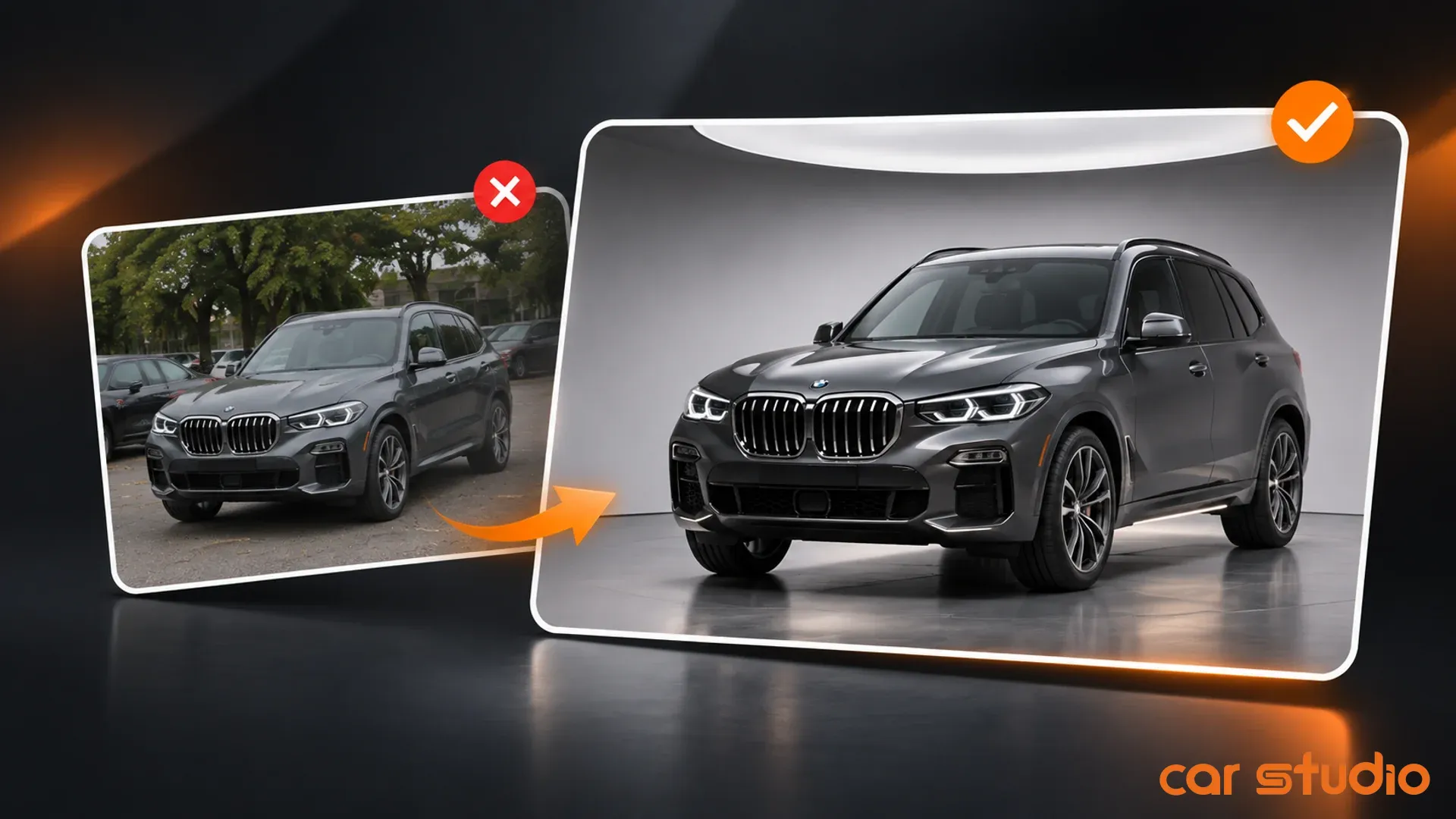
Professional car photos come from a repeatable standard, not from expensive equipment. Seven visible markers separate them from amateur shots. Three are decided when you shoot: a sharp, fully framed car, even light and consistent angles. The other four can be applied afterwards in editing: a clean background, a realistic shadow, one plate policy and a crop that fits the marketplace.
Car Studio AI is an AI-powered photo editing platform for car dealers. This guide sets out the standard for dealerships, marketplaces, OEM used-car programs and individual sellers, because all four are judged in the same listing grid.
Which visible markers do buyers react to?
All seven markers are visible in a listing thumbnail, before a buyer opens the listing or reads a single spec. That makes the thumbnail the cheapest place to win or lose attention.
Is the whole car sharp and in frame?
Every part of the car should be in focus, with a margin of space on all four sides. A clipped bumper or a soft rear wheel suggests a rushed photo. A buyer then has little reason to assume the car was handled more carefully.
Is the light even across the body?
Soft, even light shows the true colour of the paint and any marks on it. Harsh midday sun does the opposite: it throws hard shadows across the doors and leaves one side of the car too dark to judge.
Are the angles and camera height consistent?
A professional set follows the same angle sequence, from roughly the same height, for every car. When two hatchbacks from one seller are framed identically, a buyer can compare them directly instead of working around different perspectives.
Is the background clean and consistent?
Nothing in the background should compete with the car. Other vehicles, traffic cones and a half-open workshop door all pull the eye away. One backdrop across the whole stock also makes forty different cars read as a single inventory, so the seller looks organised at a glance.
Does the car sit naturally on the ground?
A soft shadow under the tyres anchors the car to the surface. Without it, the car looks pasted onto the scene, and an image that looks edited invites doubt about what else might have been changed.
Is the license plate handled the same way every time?
Pick one plate policy and apply it everywhere: always visible, always blurred, always covered or always branded. The choice matters less than the consistency, because a stock with four different plate treatments looks unmanaged.
Does the crop fit the marketplace?
Each image should be exported in the aspect ratio the marketplace uses. Otherwise the platform trims it, often cutting through the roofline or a bumper in the very thumbnail that is supposed to win the click.
What makes a car photo look amateur?
Amateur car photos usually give themselves away through capture habits rather than equipment. The most common tells are easy to avoid once you know them:
Tilted horizon: the car looks parked on a slope.
Standing too close: the wide-angle lens stretches the front of the car.
Digital zoom: detail softens and noise appears.
Reflections: the photographer shows up in the paint or the windows.
An unprepared car: dust on the dashboard or a phone charger left on the seat.
Which markers are set at capture and which can be fixed in editing?
Three of the seven markers depend on how the car was photographed, so editing cannot add them later. The other four concern the car's surroundings, which a car photo editor can change after the shoot.
Sharp, fully framed car: set at capture.
Even light on the body: set at capture.
Consistent angles and height: set at capture.
Clean, consistent background: fixable in editing.
Realistic shadow: fixable in editing.
One plate policy: fixable in editing.
Marketplace crop: fixable in editing.
How do you reach that standard from a phone?
A phone reaches a professional standard when the capture is disciplined and editing takes care of the surroundings. Studio car photos no longer need a studio, but they still need a good original.
For the capture, hold the phone level at roughly headlight height. Step back rather than switching to the wide-angle lens or digital zoom, and shoot in open shade or on an overcast day. Follow the same angle sequence for every car and leave space around it in each frame.
For the editing, the Car Studio AI Photo Editor applies the four surroundings markers to that phone photo. Car Studio AI changes the setting (background, light and shadow) and leaves the car itself untouched:
Background: dozens of indoor, outdoor and showroom options, or your own set, applied to every car.
Shadow: a realistic shadow added automatically.
Plate: keep the original, blur it, cover it or replace it with a branded plate.
Crop: export in the aspect ratio each marketplace requires.
What does the difference look like on one car?
The difference shows most clearly on a single car photographed twice. Take a silver estate shot beside a workshop at noon: the bonnet is washed out, a stack of tyres sits behind the rear wheel, the plate is readable and the marketplace crops off the tailgate.
A better capture fixes the light. The same car is moved into open shade and shot from headlight height, with space around it. Editing fixes the rest: a showroom backdrop replaces the tyres, a shadow settles under the car, the plate is blurred and the export fits the grid. The car is identical in both versions; only the photo standard changed.
How can you check your own car photo quality?
Check your car photo quality by running your current listing photos against the seven markers. Where a photo fails on sharpness, light or angles, the fix is a better capture. Where it fails on background, shadow, plate or crop, try the Car Studio AI Photo Editor on it.
Car Studio AI has processed 100M+ images for 600+ dealers in 44+ countries. You can test it on your own photos for free, with no credit card and no subscription.
Try Car Studio AI free. No credit card, no subscription.